

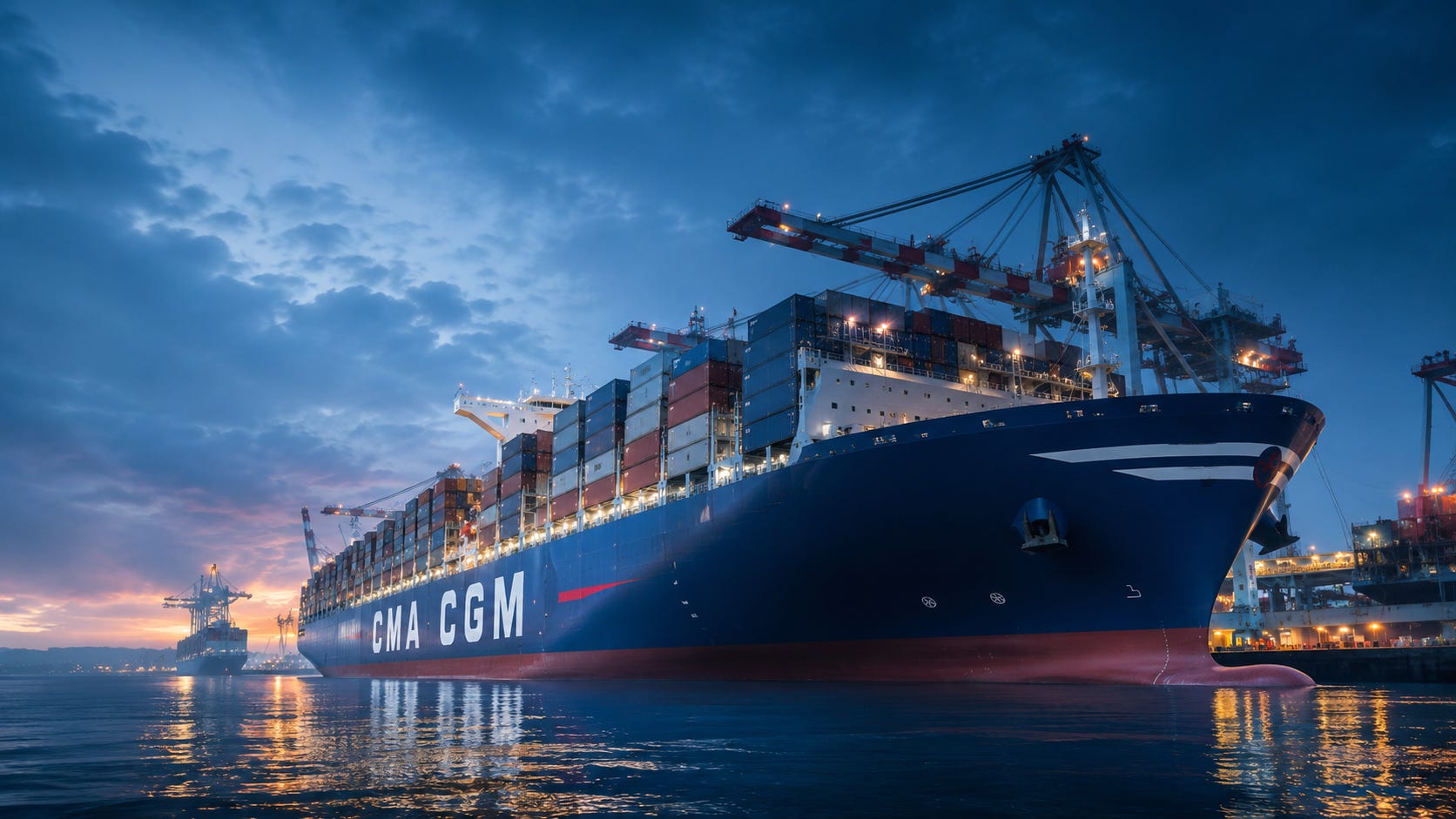
At first glance, this looks like another container ship order.
CMA CGM has contracted eight 6,000 TEU container vessels at China’s Hengli Heavy Industry.
Market estimates suggest the price is at least $80 million per vessel.
But one detail makes this order more interesting than the headline number.
The vessels are understood to be conventionally fueled.
That matters because CMA CGM has been one of the strongest backers of LNG dual-fuel tonnage.
So, what does this order really tell us?
Is it a cost decision?
A regional trade decision?
A signal about fuel availability?
Or a sign that the next fleet cycle will be more complex than the last one?
Let’s break it down.
1️⃣ The Order in One Minute
CMA CGM has reportedly ordered eight 6,000 TEU vessels from Hengli Heavy Industry.
It is believed to be the French carrier’s first newbuilding deal with the Chinese yard.
Deliveries are expected from late 2028 into 2029, based on reported timelines.
The contract price has not been disclosed.
But market estimates suggest at least $80 million per ship.
2️⃣ Why This Fuel Choice Matters
CMA CGM’s latest order is understood to involve conventional-fuel vessels.
That may look surprising at first.
Earlier this year, the carrier ordered six LNG dual-fuel 1,700 TEU feeder ships at Cochin Shipyard in India.
So, this does not look like a simple shift away from LNG.
It looks more like a trade-specific fleet decision.
3️⃣ Why 6,000 TEU Ships Are Strategic
A 24,000 TEU ship usually operates on a more fixed long-haul route.
That makes fuel planning easier.
A 6,000 TEU ship is different.
It can move across regional trades more flexibly.
And in many regional markets, LNG or methanol bunkering may still be less straightforward.
4️⃣ The Market Is Saying the Same Thing
The global orderbook for 6,000–7,900 TEU container ships stands at around 100 vessels.
Most are designed for conventional fuel.
Only 22 have LNG-ready or methanol-ready notations.
That suggests the market is not moving in one straight line.
Fuel choice is becoming more dependent on vessel size, route and deployment.
5️⃣ The Hengli Signal
Hengli Heavy Industry is also part of the story.
The yard resumed operations in January 2023 after the former STX Dalian shipyard collapsed.
Since then, it has grown quickly across several shipping sectors.
It has attracted major names including CMA CGM, MSC, EPS and XT Shipping.
It has also built a backlog of more than 60 containership new buildings in recent years.
6️⃣ Why Yard Access Matters
Many established shipyards are heavily booked until 2029 or 2030.
That makes available delivery slots strategically important.
For carriers, the question is no longer only:
“Who can build the best ship?”
It is also:
“Who can deliver the ship when the network needs it?”
In this cycle, shipyard access is not just procurement.
It is part of fleet strategy.
7️⃣ CMA CGM Is Building Options
CMA CGM is also set to charter 10 MARIC 6000 class vessels from Eastern Pacific Shipping.
Those ships are understood to have LNG dual-fuel propulsion.
So, the strategy is not one-dimensional.
Some ships are owned. Some are chartered.
Some are LNG. Some are conventional.
That is not confusion.
That is portfolio thinking.
🧭Maritime Analytica - Final Words
This is not an eight-ship story.
It is a signal that container shipping is moving from scale to optionality.
Not every vessel needs the same fuel story.
Not every trade can support the same fuel reality.
The key question is no longer:
Is this ship green?
It is:
Can it operate profitably, flexibly and realistically where it will sail?
The next cycle may not be won by the boldest fuel promise.
It may be won by the smartest fleet map.
Why would one of LNG’s strongest backers order conventional ships?