

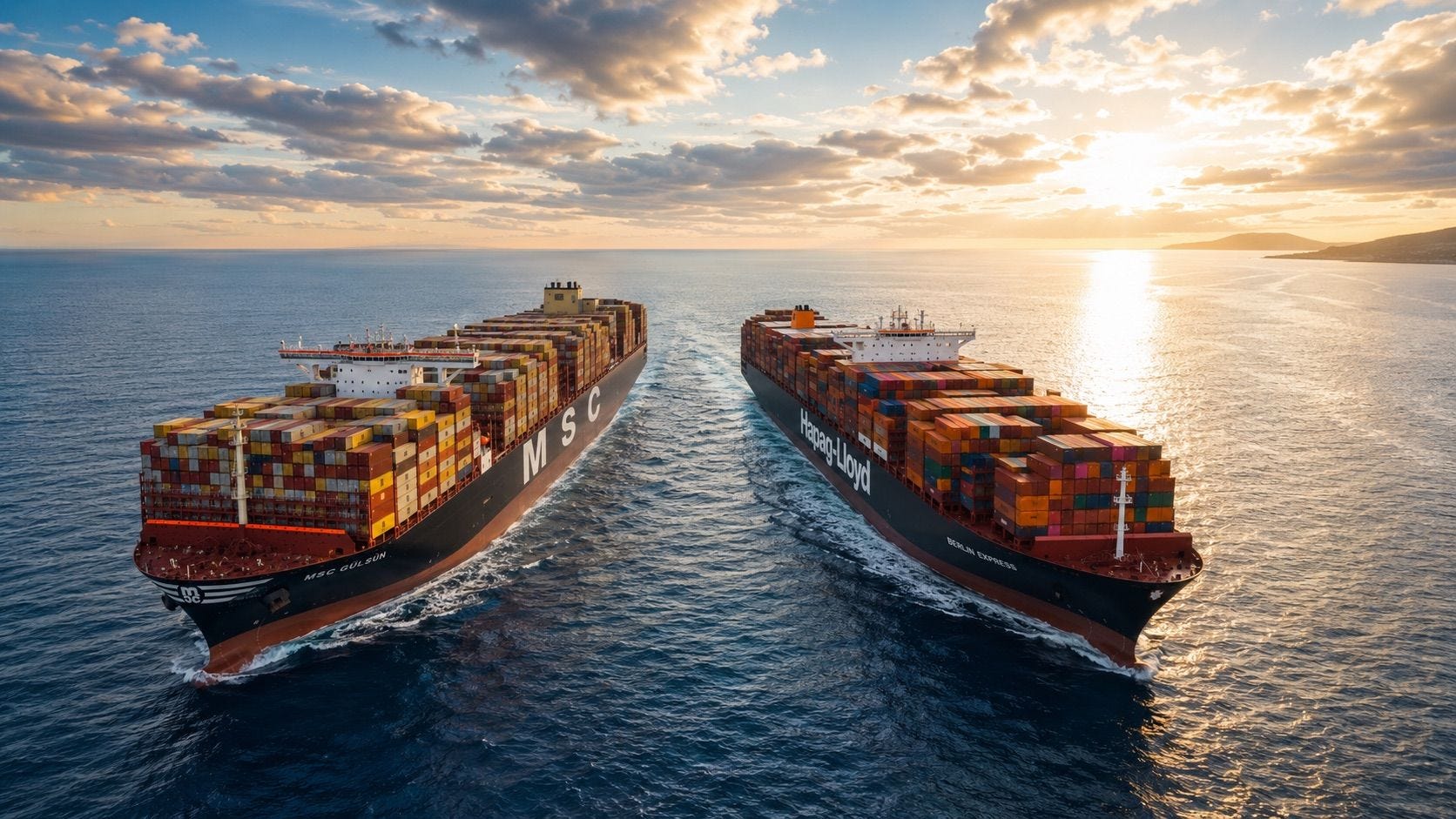
MSC has denied media reports that it was looking to buy a stake in Hapag-Lloyd.
That should be said first.
So this is not a post about predicting a deal.
It is a post about why even the rumour matters.
Because if such a move were ever attempted, it would not only test valuation.
It would test ownership.
Hamburg.
Gemini.
Regulation.
And strategic control.
Here are the 5️⃣ signals shipping leaders should watch.
1️⃣ Scale would make it impossible to ignore.
MSC is already the world’s largest container carrier.
7.3 million TEU and 21.5% share.
Hapag-Lloyd is the fifth-largest carrier, with 2.4 million TEU and 7.0% share.
So even a minority stake would not feel small.
In container shipping, scale is never neutral.
At this level, it becomes a strategic question.
2️⃣ Hapag-Lloyd has a shareholder wall.
Hapag-Lloyd is not a wide-open market target.
Its free float is only 3.6%.
Kühne and CSAV each hold 30%.
Hamburg, Qatar and Saudi capital are also inside the structure.
That makes any meaningful stake difficult.
Not only financially.
But politically and structurally.
3️⃣ Hamburg is part of the equation.
Hapag-Lloyd is not just another listed carrier.
It is deeply tied to Hamburg’s maritime identity.
The City of Hamburg-related HGV holds 13.9%.
That matters.
Some shipping assets are still treated as strategic infrastructure.
A transaction would not only be read by investors.
It would be read by Hamburg.
4️⃣ Gemini changes the optics.
Hapag-Lloyd is Maersk’s partner in the Gemini Cooperation.
Gemini delivered around 90% schedule reliability in its first year.
It operates 57 services with around 340 ships.
That is not just an alliance.
It is a network operating model.
Any meaningful MSC position would raise questions beyond ownership.
It would raise questions about network trust.
5️⃣ Hapag-Lloyd is already moving.
Hapag-Lloyd has signed a USD 4.2 billion agreement to acquire ZIM.
If approved, the combined company would have more than 3 million TEU capacity.
It would operate more than 400 vessels.
And it would transport more than 18 million TEU annually.
That is the important point.
Hapag-Lloyd is not only a name in consolidation rumours.
It is also an active consolidator.
🧭 Maritime Analytica — Final Take
MSC denied the report.
That matters.
But the rumour still reveals something bigger.
The next phase of container shipping will not be shaped by fleet size alone.
It will be shaped by permission.
Permission from shareholders.
Permission from cities.
Permission from alliance partners.
Permission from regulators.
And permission from customers who depend on network trust.
For CEOs, the question is no longer only: “Who has the biggest fleet?”
The sharper question is: “Which parts of our network are ownable, defensible and politically acceptable?”
That may be the real limit of consolidation.
Not money.
Permission.
MSC denied it. But the strategic questions behind it are very real.